From: Zach
Subject: Record label submissions
Hey Mike,
From: Zach
Subject: Record label submissions
Hey Mike,
Tagged e-mails, marketing, music, music industry, record label
Last February, DigitalMusicNews published an article outlining how Grooveshark.com, the on-demand music streaming service, is leagues ahead of Spotify, a similar service that recently launched in the US. Half a year later, is this still the case?
With users illegally downloading more than they’re buying (a recent statistic claims 95% of all music downloaded online is pirated) and profits dwindling across the board, the subscription-based model seems like a fantastic compromise (or, at the very least, the lesser of two evils.) Instead of stealing an album online, you can pay $5/month (for premium services) for access to millions of songs (or, at the very least, get limited access for free.)
So it makes sense that Grooveshark, with LESS intrusive advertisements and a BETTER selection, is actually better than Spotify. Is DigitalMusicNews right?
No. Here’s why Spotify is kickin’ Grooveshark’s butt:
1. Business model – Spotify has a better one. The free version relies heavily on ads, and, indeed, they are everywhere — graphic overlays, audio spots, etc. While DigitalMediaNews says that Grooveshark’s less intrusive style is a plus, I disagree. Sure, ads are annoying, but they help create revenue. They also give incentive for people to buy the premium version, which is where the real money is made. With premium, not only do I get to stream music through my phone, but I also get to get rid of those pesky ads. Spotify is, simply put, better at generating conversions, which equals more money. Indeed, Spotify has given out over $100 million to the industry.
2. Compliance – The amount of money behind Spotify give it immense power in the music industry. We will, almost certainly, see it become a key player in shaping things to come. Why? Because, for most of the industry, it’s better than the alternative: Pirating music. Spotify has encouraged this relationship, cultivating strong relationships with labels and bands, and branding itself as the new model for the recorded music business.
Grooveshark, on the other, has effectively thrown up a huge middle finger to the industry. Protected in the USA by the DMCA act, and flat out ignoring laws in other countries, Grooveshark prides itself on its defiance. Not a great long-term business plan.
3. Innovative marketing – Spotify’s compliance has allowed itself to gain legitimacy in the business world. This has paved the way for some impressive corporate tie-ins. While still trickling out invites the first weeks of its American release, Spotify was able to align itself with heavy-hitters such as Coca Cola and Scion. They also recently announced a partnership that has put it leagues ahead of ANY competition: Facebook. They have cleverly woven itself into the fabric of Facebook and, in doing so, secured itself as king for many years to come.
4. Better technology – I wouldn’t underestimate this one. Spotify represents what users need: A crisp, clean, and fast program. It’s purposeful imitation of iTunes simple design offers almost no learning curve. The stand-alone app keeps it punchy and lightweight, and its no buffering feature makes you forget its streaming at all!
Grooveshark, while relatively well designed, has some serious flaws it needs to work around before it can compete. First off, it’s bulky flash-based interface is prone to bugs and inconsistencies. It’s user-uploaded database of songs is often mislabeled and its poor cataloging returns multiple instances of the same song. Grooveshark’s web-based app leaves it more open to hacking, such as programs that allow you to download songs from their library.
Sure, Spotify has problems with it. With controversy surrounding how it pays out its artists and structures it deals with labels, and incomplete music library (particularly for classical music and recordings from the 60’s), we’re nowhere near the finish line. Still, to suggest that it’s closest competitor, Grooveshark, is ahead of Spotify in the race is a hard stance to defend.
Posted in music, technology
Tagged grooveshark, music industry, spotify, streaming, technology
Profits are dwindling in the recorded music industry, so we have to stretch our creativity to find new revenue streams.
Unfortunately, this isn’t what I had in mind:
Interscope Records Used in Cocaine Ring
The record company that distributes the music of U2 and Lady Gaga was used by a drug-trafficking ring as a way station for cases stuffed with cocaine and vacuum-packed $20 bills, according to federal prosecutors.
The allegation was contained in a letter detailing evidence against James Rosemond, a music-industry manager who was indicted in June on drug-trafficking and related charges. Mr. Rosemond, who goes by the nickname “Jimmy Henchmen,” has been in custody since shortly after his indictment.
In the world of touring and live music, an ongoing debate exists about which of two deal structures are more appropriate: Guarantees or Door Deals. If guarantees are like being paid a salary, door deals are an hourly wage. With a guarantee, the artist pay for the show is…well, guaranteed, upfront. You get paid the same amount no matter how few people are there, so, in a sense, it’s similar to a salary that doesn’t account for how few hours you work (indeed, if the show does particularly well, there’s usually a bonus). A door deal is based on how many people walk through the doors (usually a percentage of the gross sales after a certain amount of expenses are covered), so if not a lot of people show up (or, for our analogy’s sake, you don’t work many hours), you don’t get paid a lot.
The door deal intuitively makes sense. Why should you pay more than the band is worth, right? Unfortunately, the argument starts breaking down when you begin adding in the complexities of promotion.
Although it’s tempting to look at each individual show as an isolated bubble, it would be like evaluating an employee based on the strength of each individual day. Employees of (most) serious jobs want to see that their boss is invested in the long-term by offering a salary and, similarly, many agents want to see the promoter invested in their artists. In my eyes, what a promoter’s long-term plans for the band are is more important than how much they pay per show.
The other side-effect from taking a door deal is that it takes away any incentive for the promoter to promote the show. If the promoter isn’t going to lose money if the show does poorly (since he’s not putting any money into the show), then why would he or she waste their resources on marketing/advertising it? It places the burden of promotion with the artist, who might not be as familiar with the market.
Of course, guarantees take away the risk for artists to some degree as well. I would argue, though, that the backend (bonus) of a deal provides plenty incentive for an artist to promote. An artist can make a hell of a lot more money, and build great relationships, by helping market the show and getting a bonus. I also believe that the venue has many more opportunities to make up for lost money at the door, as they have bar sales, parking, and all sorts of ancillary income to account for.
In reality, there’s a time and a place for both deals. Obviously if you are confident in your draw in the market and are ready to take care of the promotion yourself, then a door deal would work (I’m sure the promoter will love you more for it.) Otherwise, guarantees help share the risk of the show, strengthen the promoter/agent relationship by working as a team, and might make more sense in general.
Whew…that was a lot of thoughts written down, but what do YOU think? Am I on the nose? Am I way off base?
Tagged booking, live music, marketing, music industry, promotion, touring
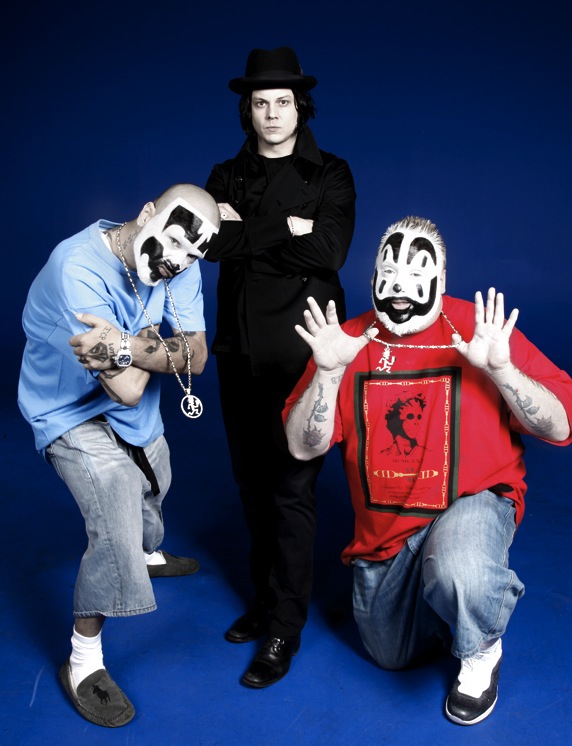
“Jack White Collaborates With Insane Clown Posse to Cover Mozart. For Real” – Pitchfork.
Got into the office this morning to learn that one of my most revered artists, Jack White, collaborated with one of my most hated artists, ICP, to cover an artist I am more or less indifferent about, Mozart. Mind…officially…fucked…
As someone in the office so eloquently put it, “They’ve got Pro-Tools on cell phones now. You can create and master a song while taking a shit, which is exactly what they’ve done.”
The article with a stream of the song is below.

http://pitchfork.com/news/43861-jack-white-teams-up-with-insane-clown-posse/
Finishing up a www.stoogesmusicgroup.com re-design. I wrapped it around Joomla, as that’s the CMS I am currently most familiar with (and provides me enough functionality for what I need.)
The idea was to give it a little bit of a edgier, sleeker look. What do you think?
NOTE: The following is a re-post from my days working as an intern at the Webster Theater in Hartford, CT (prior to getting hired as a full time manager.) I thought it’d be fun to write about all the interesting stuff that went on there. It was fun. Two posts later, I realized it was a lot of work.

THURSDAY, JULY 3, 2008 – MINDLESS SELF INDULGENCE, JULIEN K, THE BIRTHDAY MASSACRE
Posted in music
Tagged band, connecticut, music industry, old posts, webster theater
NOTE: The following is a re-post from my days working as an intern at the Webster Theater in Hartford, CT (prior to getting hired as a full time manager.) I thought it’d be fun to write about all the interesting stuff that went on there. It was fun. Two posts later, I realized it was a lot of work.

SATURDAY, JUNE 28, 2008 – First post
Let’s pick up with today. Today was a two-fer in the sense that we had a production company rent out the main stage for a battle-of-the-bands, while we threw a show in the smaller second stage, the Webster Underground. The production company was called Gorilla Productions and was holding a regional semi-final battle of the bands. Hearing the gruff hardcore vocals resonating through the walls made it easy to see why the contestants’ parents were huddled in the bar, trying to drown out the screeching Gibson’s with a cold Bud-Light.
Continue reading
Posted in music
Tagged band, connecticut, music industry, old posts, webster theater
Below is an article I drafted while applying to be a writer for eHow.com about promoting your upcoming gigs. Am I missing anything? What do YOU think?
HOW TO PROMOTE YOUR BAND’S GIG
For touring bands who cannot afford a publicist, they’ll have to take on the responsibility of helping the promoter get the word out about their upcoming gig. Indeed, this is an excellent way to build a relationship with the promoter and a crucial step in getting people to your show.

Veteran Indie/Dream pop/noise rockers the Olivia Tremor Control played tonight at One Eyed Jacks. It was their first show of 2011 (possibly longer) and it showed. While all the favorites were played (including 10 songs, all named Green Typewriters) and they drifted in between unadulterated noise and beautiful melodies seamlessly, songs where cut short, lyrics were forgotten, and the professionalism was all-together lost.
Good show, but they translate much better in studio.
The fact they must’ve been tripping balls probably didn’t help…I mean…I swear… I get it that they are the weird artist type, but when 80% of your sentences trail off…
Have you ever heard of these guys? Seen them live? Am I way off base here?